Wednesday, June 23, 2010

Lodz - All My Lovin


Back in May I made my third visit to the surprising Polish city of Lodz to visit the 2010 edition of the city's photography festival. Under the banner of All My Lovin, the festival dealt broadly with the issue of relationships. Directed by astute, young and enthusiastic Krzysztof Candrowicz, every year this festival gets better and better!

The festival is centered on the Lodz Art Centre with shows in other venues around the city. The substantial, well designed catalogue detailed the many exhibitions. Divided into main programme and grand prix here there were around 30 exhibitons all of substance. These supported by a photo schools review.

Almost without exception the shows that I saw were single minded and well executed. I guess for me looking at work dealing with matters of the heart I gravitated to the work that came from the heart and had an obvious depth of authenticity. Inevitably though two or three shows appeared contrived and in my opinion effect replaced substance. A slippery slope we all must avoid.

The stand out shows:

Phillip Toledano - Days with my father (2006-2009)
A simple heart felt record of the photographers last days with his dying father

Carolle Benitah - Just the two of us (1994 - ongoing)
A portrait series documenting the evolving relationship between the photographer and her son

Katrin Trautner - Morning Love (2008)
A series celebrating aging, countering societies obsession with youth

The photographs above are spreads from the All My Lovin catalogue of the three shows mentioned here.

If you ever get the chance to visit Lodz for this festival do so. Not only is it a great festival but the city is strange, enigmatic and quite wonderful. Overlay that with the warm, welcoming and friendly Poles and you have a winning combination.

Tuesday, June 22, 2010

Sotheby's Polaroid sale - highlights


The sale of the Polaroid collection held at Sotheby's New York on Monday and Tuesday of this week realized USD 7,197.439.
Here are some highlights:

CHUCK CLOSE
'9 PART SELF PORTRAIT'
Estimate: 50,000—70,000 USD
Lot Sold. Hammer Price with Buyer's Premium: 290,500 USD
DESCRIPTION
a composition of 9 unique large-format Polaroid Polapan flush-mounted prints, signed, titled, and dated in ink in the lower margins, affixed to a mount, framed, 1987

ROBERT RAUSCHENBERG
JAPANESE SKY I (FROM THE BLEACHER SERIES)
Estimate: 40,000—60,000 USD
Lot Sold. Hammer Price with Buyer's Premium: 242,500 USD
DESCRIPTION
a composition of 4 unique bleached Polaroid Polapan prints, mounted to aluminum, signed and dated in silver ink on the mount, in a frame designed to the artist's specifications, an Innovation/Imagination exhibition label on the reverse, 1988

ANDY WARHOL
SELF-PORTRAIT (EYES CLOSED)
Estimate: 10,000—15,000 USD
Lot Sold. Hammer Price with Buyer's Premium: 254,500 USD
DESCRIPTION
unique large-format Polaroid Polacolor print, 1979

ANSEL ADAMS
CLEARING WINTER STORM, YOSEMITE NATIONAL PARK
Estimate: 300,000—500,000 USD
Lot Sold. Hammer Price with Buyer's Premium: 722,500 USD
DESCRIPTION
mural-sized, flush-mounted, framed, 1938, probably printed in the 1950s or 1960s

Sunday, June 20, 2010

Polaroid collection sale - Sotheby's Manhattan, this week


NEW YORK (AFP) - More than 1,000 photographs from the historic Polaroid collection, including works by Andy Warhol, Ansel Adams and Chuck Close's gigantic "9-Part Self Portrait," go under the hammer in the coming week at Sotheby's.
The auction was ordered by a bankruptcy court in northern Minnesota and proceeds from the sale will go to creditors of the failed company. Polaroid has filed for bankruptcy twice, in 2002 and 2009.
The auction will be held Monday and Tuesday, following a weeklong exhibition of what are considered the best photographs in the collection -- the complete collection numbers about 16,000 pictures -- at Sotheby's Manhattan offices.

Ranging from classic Polaroid snapshots to rare gelatin silver prints, the collection was amassed over the years by Polaroid company founder and inventor (1948) Edwin Land and his technical director and photographer Ansel Adams, 400 of whose snapshots are included. Land sought to build his collection and allowed Adams to buy at the company's expense classic examples of photo greats like Harry Callahan and Dorothea Lange, whose famous "Migrant Mother" (California, 1936) is estimated at 60,000 to 80,000 dollars. "Ansel wanted a larger collection to show creativity in photographs," said Sotheby's photography department director Denise Bethel. Some of Adam's mural-size photographs are among the collection up for auction, including "Moonrise, Hernandez, New Mexico," which is estimated at between 300,000 and 500,000 dollars.

The auction is estimated by Sotheby's to bring in 7.2 million to 11.1 million dollars.

Included in the collection is a huge, one-of-a-kind, one-by-two-meter (40x80-inch) Polaroid camera used by Chuck Close for his immense portrait composed of nine, 50 centimeter-by-60 centimeter (20x24-inch) snapshots. It is expected to fetch 40,000-60,000 dollars.

"In the 50-60s, Ansel Adams started sending out cameras to artists for feedback. The artists would exchange their prints for the use of Polaroid cameras. In the late 60s, this unique situation was called 'the Artist support program,'" said Bethel.
A favorite of families and tourists, the Polaroid camera also had a following among legendary photographers and painters like Robert Mapplethorpe, Robert Frank, Andy Warhol and Robert Rauschenberg, some of whose snapshots will go under the hammer. Other, lesser known artists such as David Levinthal are also included and Sotheby's hopes interest in the Polaroid collection will boost their worth.

Polaroid was bought up in 2009 by The Impossible Project group, which is trying to revive the market for the fabled instant camera and has named eccentric pop-singer Lady Gaga as its artistic director.

Photograph: Edwin H. Land demonstrating instant camera, 1947.

Thursday, June 17, 2010

ONE DAY - TEN photographers


At Paris Photo in November last year I talked to Gerry Badger about "print on demand" publishing and how it was possible to make a book in a day. From that conversation came the idea of getting a group of photographers together to all shoot a book in a day.
John Gossage came on board, so did Martin Parr, Jessica Backhaus, Eva Maria Ocherbauer and Rob Hornstra who were all at Paris Photo. Publisher Klaus Kehrer of Kehrer Verlag in Heidelberg liked the idea and agreed to publish a set of individual photobooks.
The idea gestated into 2010 and was again talked about in May at the Kassel Photobook Festival. Alec Soth joined the group and so did Rinko Kawauchi who were both at Kassel. A last and final participant was Todd Hido.

The ten photographers and where they are shooting, Monday June 21st.

Jessica Backhaus - Berlin
Gerry Badger - London
Harvey Benge - Auckland
John Gossage - Baltimore MD
Todd Hido - Oakland CA
Rob Hornstra - Utrecht
Rinko Kawauchi - Tokyo
Eva Maria Ocherbauer - Berlin
Martin Parr - Bristol
Alec Soth - Saint Paul MN

The individual hardcover books, contained in a slip-case will be launched at Paris Photo, 18 -21 November.

Wednesday, June 16, 2010

Schaden.com - possibly the World's best photobook store


If you were ever wanted a reason, other than to see the Cologne Cathedral, to visit that pleasant riverside city, it would be to immerse yourself in photobooks at the store-front location of Schaden.com. Established by Markus Schaden and brother Christoph, and now located at 4 Albertustrabe, the shop probably has the best selection of photobooks you will find anywhere. But there is more. You will probably find Markus sitting at his desk at the back and here is a man that knows more about photobooks than just about anybody else I can think of of. Well at least as much as Martin Parr. And that's quite a lot!
And at Schaden.com it's not just your run-of-the-mill Amazon titles, you will also find special editions, signed copies, hybrid books, and titles published by Schaden themselves. Plus innovative projects like The La Brea Matrix.
And if you follow the photofestival circuit you will often find Markus and his team at the best photofestivals; Paris Photo, New York, Los Angeles and the Kassel Photobook Festival.
If you aren't planning a visit to Cologne in the near future you can visit Schaden.com on-line. If you haven't been there already a treat is instore..... enjoy.

Here are some pictures I made at Schaden.com when I was there in May.

John Gossage and Alec Soth - The Auckland Project


When John and Alec were in Auckland in January last year for the annual AUT St Paul St workshop they worked on a book project which originated broadly from the book Obvious and Ordinary that Martin Parr and John had made in Memphis in 2006. John tells me that Darius Himes at Radius books has picked up the project and the book should be available at Paris Photo in November. Already, John tells me, the book is Number One on Photo-Eye's current best selling list.

Photo-Eye has this to say about the book.

The Auckland Project.
Photographs by John Gossage and Alec Soth.
Radius Books, 2010. 160 pp., Two volumes, 80 color illustrations, 9x11½".

In the Spring of 2009, John Gossage and Alec Soth traveled together to New Zealand to work on a joint photography project. For both, it was a trip of departures. Gossage has been creating photographic literature in black-and-white for over 40 years, and this trip yielded one of the first bodies of work he had ever produced in color. Soth’s work with the 8×10 view camera has inspired an entire generation of his contemporaries, and leaving it behind was key to approaching the world from a fresh visual perspective. The results represent a major shift of vision for these two vastly important American photographers.

This publication represents the culmination of that trip. Both the concept and the content of the book have been driven by the uniqueness of the collaboration and the primacy of the photobook to the artistic practice of both Soth and Gossage. Essentially two books in one, The Auckland Project showcases a playful attention to materials and presentation that marks all Radius Books projects. Unlike 2007’s Obvious & Ordinary in which Martin Parr (in his signature color) and John Gossage (using black-and-white) published the results of a road-trip across the American South, this volume presents the two photographers’ work separately, creatively combined through the device of the book and its housing.

The photograph is by Alec Soth made in downtown Auckland minutes before heading to the airport to fly home.

Tuesday, June 15, 2010

Photographers whose work I like - No 5 / Onaka Koji


It was a pleasure to meet Onaka Koji at the Photobook Festival in Kassel. We swapped books, my Tokyo book YOU ARE HERE for his book The Dog in France, this for him an escape from Tokyo with no particular motive or design. Known for both his color and black and white work Koji's photographs are quietly understated. The black and white photographs in The Dog in France are rich and dense with mysteries lurking in the heavy shadows. Photographs about not much and everything at the same time.

He says of his work: "They are not astonishing scenes, nor are they taken with superb timing. They do not convey mystifying sensations or intense impressions. They do not have healing effects, but neither do they push away viewers. They are not difficult to understand, but they do not provide any definite answers. Much less are they stories or documentaries.”

If you're in Paris The Onaka Koji show is still running at Plac'Art gallery 5 rue de l'ancienne comédi, up until June the 15th.

Monday, June 14, 2010

Marks of Honour at Photographers Gallery


13 contemporary photographers create a striking library. MoH/08 was curated and organized by Nina Poppe and Verena Loewenhaupt. Exhibited at FOAM Amsterdam and Kaune, Sudendorf Gallery Cologne the exhibition opens Wednesday June 16 at Photographers Gallery, London.

Harvey Benge honours William Eggleston
Artist book of 16 pages, hand written text and four tipped in photographs, one inserted loose. Both books contained in a slipcase.

Chris Coekin honours Hendrick Duncker & Yrjo Tuunanen
Book in hay and eco/farmer bag, four pictures of me hitchhiking plus one of the original signs "Hay on the Highway".

Peter Granser honours Robert Frank
Box from linnen with book and a map with four pigment prints on Fine Art Pearl Paper.

Pieter Hugo honours Roland Barthes

Tiina Itkonen honours Pentti Sammallahti
Box with five pictures.

Onaka Koji honours Daido Moriyama
Book, contactsheet and five pictures in handmade wooden box.

Jens Liebchen honours Anthony Hernandez
A sequence of 3 images presented as a Leporello, with text and separate book, in a cardboard box.

Michael Light honours Ansel Adams
Box, Adams book digsawed along landscape lines; M. Light pigment prints atached to certain Adams images.

Mark Power honours Stephen Shore
Custom made box with book and four large format c-prints.

Matthew Sleeth honours Lars Tunbjörk
A fold out book with „Office“ bound to the middle and then two selfmade inkjet books („Fire extinguishers“ and „Houseplants“) each side folding over the top.

Alec Soth honours Andrea Modica
The edition includes a box with two photographs in a small portfolio responding to Andrea Modica’s Treadwell.

Jules Spinatsch honours Block 2008
8 booklets made out of the calender Block 2008; one for each artist in a box with the title: Deblocked.

Raimond Wouda honours Paul Shambroom
3 pictures as inkjets in the book; they continue the book as leporello.

Jochen Lempert at Museum Ludwig Cologne


Back in May I had saw the show of Jochen Lempert's work at Museum Ludwig. I'd never seen or heard of this artist and the quiet subtleness of his photographs were a surprising revelation and a reminder that something quite profound can be made from almost nothing. Made from the heart with no try-hard artifice, the photographs had a simple beauty both in execution and presentation. The shows closes June 13.

Here is an extract from a review of Lempert's show at Culturgest, Lisbon published in Aperture, Winter 2009

Seen one at a time, Jochen Lempert’s black-and-white photographs of the natural world and its inhabitants do not make great claims upon a viewer. Some have artless compositions; others seem out of focus or to have no subject at all. Encountered in aggregate, however, as in Field Work, the first major survey of Lempert’s photographs presented outside his native Germany, they possess a quietly mesmeric force. This exhibition, organized by Miguel Wandschneider, was an unforeseen revelation. Its scores of images, printed at modest scale on thick paper that the artist allows to warp slightly as it dries, were presented unframed, either singly or in rows and grids according to subject. These arrangements collapsed the distinctions between documentary naturalism and lyrical Conceptualism, the two contemporary photographic genres into which one is tempted to slot Lempert’s work. That Lempert’s silver-gelatin prints look more like charcoal drawings than they do conventional photographs further accentuates the artist’s singular achievement.

Lempert trained as a biologist before embarking upon his work as a photographer in the early 1990s, and the scientist’s rigorous avidity was one of this exhibition’s leitmotifs. He pursues his (mostly avian) subjects intently, finding them both in the field—whether urban or rural—and in the natural history museum. One series of images, each printed smaller than a sheet of letter-size paper, depicts lone cormorants moving gracefully through various urban environments: one is silhouetted against the sky between an imposing skyscraper façade and the delicate filigree of tree branches; another hovers just above a river’s surface at the bottom of a picture dominated by an apartment tower and a bridge. Still others register the concentric ripples set off by the birds’ feet as they flap across unknown waterways, evoking Adam Fuss’s tranquil studies of splashes. Several other series, arrayed in grids, depict the heads and beaks of various taxidermy specimens in a uniform style, calling to mind not only the presentations in natural-history museums but also Richard Prince’s collections of women extracted from advertisements and Bernd and Hilla Becher’s industrial censuses.

Sunday, June 13, 2010

Auckland - back!


Arrived in Auckland yesterday, Saturday morning after leaving Heidelberg Thursday afternoon. When I've recovered from jetlag and the sudden shift from summer to winter I'll post some thoughts, observations and pictures looking at what I've seen and done over the last 6 weeks in Europe. Watch this space.....

Tuesday, May 18, 2010

Art comes of age as an investment for the wealthy

NEW YORK17 (Reuters) - International businessman Nicolas Berggruen, the son of a famous art dealer, saw a rare opportunity to expand his father's renowned Picasso collection during an auction this month, but he was left empty-handed.
Fierce bidding at the New York sale may have sparked a degree of regret, but not surprise. Art lovers and investors from around the globe pumped prices of master works to record heights.

Berggruen said soaring prices at auctions and other signs suggest a growing market for art as investment with the very rich seeking tangible assets as the global economy remains "shaky." "People have less and less confidence -- you can see in what's happening with the euro right now -- in paper money and more confidence in real things that are lasting, art being one of them," said Berggruen, who ranked No. 158 on the Forbes list of the 400 richest Americans in 2009. Berggruen, who is accumulating works for an expansion of Berlin's Museum Berggruen, discounted the notion of a bubble forming in the art market. Two days after the auction, he wondered if maybe he should have gone further in bidding.

Asher Edelman, the founder of ArtAssure, Ltd., which guarantees prices on portfolios at auction, said art has never been in greater demand as an investment and is sought after by traditional buyers and those in emerging markets.
"You're at the beginning of the up-cycle in art," he said, adding that international buyers are suddenly playing a much larger role. "It's become an asset class, either subconsciously or consciously, for everybody."

Art buyers who have not had the opportunity to purchase much since the financial crisis erupted in 2008, approached the spring auctions in New York with pent-up demand, Edelman said.
Pablo Picasso's "Nude, Green Leaves and Bust" sold for $106,482,500 on May 4, a record for art sold at auction. The total $224 million take from the collection of the late Los Angeles patrons Frances and Sidney Brody, was the third best for Christie's.

Christie's Chairman Marc Porter said the auction house does not encourage buying art purely for investment.
"We recognize that clients are more keenly aware of alternative investment opportunities while the global financial markets remain somewhat volatile, and fine art is a stable store of value that tends to appreciate over time," Porter explained in an e-mail. "Our most recent sales in New York were a perfect demonstration of that."

The record-breaking Picasso had been bought for $17,000 in 1950.

Turmoil in world stock markets over the past month and its impact on other securities and commodities markets should underscore the role that art can play in a portfolio, Edelman said. Other real assets, such as real estate and precious metals, have carrying costs and trading restrictions, while art has fluency as a currency, he added.
Edelman thinks most money will be worthless over time as nations devalue currencies and inflation soars. The euro is falling hard, and since December has dropped to its lowest in 18 months as debts of Greece and other euro zone nations are seen crippling regional economies. Drawing from experience in financial options while working with Nobel Prize winning economist Harry Markowitz in the late 1960s and early 1970s, Edelman and his staff are developing models that quantify everything around art sales aside from the subjective, such as historical price volatility and auction prices relative to estimates.

Thursday, May 13, 2010

Photographers whose work I like - No 4 / Wolfgang Zurbon


I have known Wolfgang Zurbon for a number of years now. We met first at the Arles Festival in the South of France and whenever I'm in Cologne, where I write this now, Wolfgang kindly provides a bed and hospitality. Apart from his photography practise, Wolfgang and business partner Tina Schelhorn have run their active photography gallery, galerie Lichtblick for over twenty years.
Wolfgang's photographic sensibility is most certainly not of the Becher school. His work looks at strange realtionships, found in life wherever he looks. Bizare, highly colored and full of humour.
Here is some of his most recent work made for a commisioned project looking at the region of Rhein-Sieg-area near Cologne.

Wolfgang writes, "The unique possibilities presented by the medium of photography are comprised precisely of the dialogue with the outside world and the ability to continually question the perception of it according to one’s criteria, in order to expose it, transform it into a visual experiment. The key to the quest for order in photography, involving the interplay of bodies, objects, signs and spaces transforming them to a legible structure, to a comprehensible composition, is not to lose sight of chaos. It is exactly this “Drift” in the every surroundings that gives these photographs its unlimited liveliness."

Saturday, May 1, 2010

On The Move....


.... I will be in Cologne from Monday this week, then the weekend of May 8 & 9 in Poland for the Lodz fotofestival. The weekend after that back in Germany for the photobook festival in Kassel. Then to Heidelberg for the prepress production on my new book.
Paris from May 19 until June 6. Back to Heidelberg for the press-pass on my book and will fly out of Munich for home on June 10.

So with regret my blog postings will be few and far between for the next 6 weeks. Hopefully lots to report when I'm back.

Meantime, here's a picture of my studio space, empty of me but crowded with stuff......

Tuesday, April 27, 2010

AGAINST FORGETTING


Here are some spreads from my new autobiographical photobook AGAINST FORGETTING. It's a 32 page, 100 copy, print on demand edition.

I've written this in the book by way of introduction and explanation:

For the first thirteen years of my life I lived with my parents in the Auckland suburb of Mt Roskill. Our family home was a modest, two bedroom, flat roofed, weather-board house, which my father had built around 1940. The suburb is known for its volcanic peak, 110 metres in height, one of the many extinct volcanic cones that dot the Auckland isthmus. Mt Roskill has been referred to as the Bible Belt of Auckland with more churches per capita than any other New Zealand suburb.

Now, after more years than I care to think about I’ve gone back to look at my past. Where I grew up. So much has changed. Other things, very little. Here are some photographs. Against forgetting. Harvey Benge, Auckland, April 2010


Copies are available at 25 Euro plus postage, please contact me at: harvey.benge@xtra.co.nz

Monday, April 26, 2010

The World's Best Photographs


This is a book I came across in a Thrift Shop here in Auckland. I bought it for the cover, well how could I resist, The World's Best Photographs. Clearly a case of hyperbole if ever there was.
Published in Britain in 1947 the book has photographs from Europe, the United States, Australia and New Zealand, all selected by the editor following an invitation for photographers to submit prints for consideration.
Divided into six categories, action, expression, landscape, children, animals, design and pattern, the book even includes Henri Cartier-Bresson's now famous picture Children of Seville made in 1933.
It's interesting that the book was published the same year the Magnum picture agency was founded. Perhaps at the time Cartier-Bresson had been looking for some exposure and the Magnum machine had yet to kick in. Who knows?
There are also photographs from New Zealand photographers Ellis Dudgeon who was a Nelson studio photographer and a certain E T Robson. Inevitably there are war photographs too..... most pictures don't rise much above the cliche, certainly measured against todays way of seeing.....

Auckland - some new photographs


Here are a few pictures I've made around Auckland in the last day or so..... not made with any particular intention in mind, just because they were there....

Tuesday, April 20, 2010

Penn photos highlight of Christie's $9.3m sale


NEW YORK, April 19 (Reuters) - Sales of nearly $10 million of photographs, including works by Irving Penn, at Christie's showed that international collectors are willing to pay top dollar for rare images.

The Penn photographs, the largest collection of his work to be sold at auction, were given to his personal assistant Patricia McCabe over 30 years. They fetched $3.8 million of the $9.3 million from three auctions.

"What we realized even in the recession is that there really is quite a strong market for the right sort of material," said Laura Paterson, of the photography department at Christie's, adding that works that are rare, important and have great provenance sell whether the market is good or bad.

Penn's photographs of objects and people are visually simplistic but they convey a deeper story. Often in black and white, the images beg for deeper observation.

Broken Egg, New York, 1959 was a surprise hit, fetching $206,500 after an original estimate range of $7,000 to $9,000. Paterson said it showed that placing a price tag on rare photographs is not an exact science.

"I think it speaks to kind of the Penn market generally, which was strong -- strong last season immediately after his death ... His prices are going to remain extremely strong. Everything was very fiercely competed over," she said.

Penn's 2 Guedras, which sold for $314,500, was the highest selling photograph from the photographs given to McCabe.

"What was really nice about the collection, and I think reflected in these prices, was the condition of these prints and how beautiful they were. We see the image a lot in platinum and it's not an uncommon photograph. But these images were absolutely beautiful, in great shape. So not only do they have the provenance, they have perfect condition," Paterson added.

Penn's Woman in Moroccan Palace from a separate private collection sold for $446,500.

French photographer Eugene Atget's Joueur d'Orgue set the world auction record with a sale price of $686,500 during the two-day sale last week.

The auction bodes well for Christie's next big auction of fine art photography which will be held in New York in October.

"We choreograph our sales very carefully, so we will be looking for material that we think will do equally well and create just as much excitement. The market clearly gave all of the houses a signal by responding warmly to rare and important things," Paterson said. (Reporting by Bernard Orr; Editing by Patricia Reaney)

Two Guedras, Morocco, 1974

Woman in Moroccan Palace (Lisa Fonssagrives-Penn)
Marrakech, 1951

Sunday, April 11, 2010

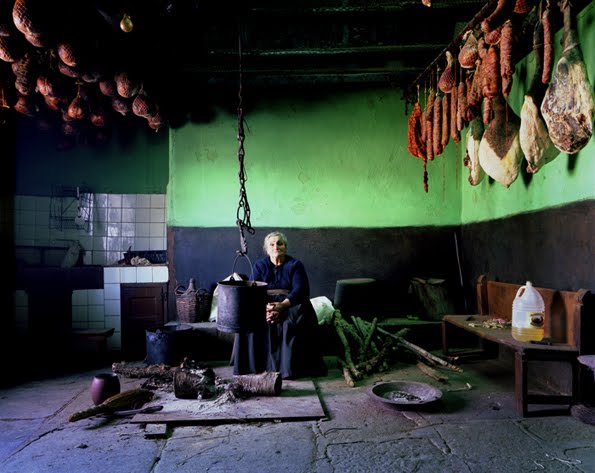
Photographers whose work I like - No 3 / Bert Teunissen


I first met Bert Teunissen at the Noorderlicht Festival in Groningen, Holland. I wandered into a gallery that was showing some of his Domestic Landscapes. Bert was there we met and talked. I've been a fan of his work ever since. It's great to see work you admire and know you could never do it yourself.

Bert has this to say:

For the last thirteen years I have been working on a photography project called Domestic Landscapes. This project is about light - natural daylight. The photos show how daylight illuminates the domestic interior, and how it dictated the way the interior was build, used and decorated. This specific light and the atmosphere it creates have their origins in the architecture of the pre-electricity era, when daylight was the main source of light. This kind of light started to disappear from European homes after World War II when the old way of building was abandoned. At this moment few of these homes remain.

Domestic Landscapes is also about identity and diversity. Every country, every region has its own distinctive culture that can be recognized in its homes, customs, cuisine and traditions.

The inhabitants of the houses where I take photographs still know how something ought to taste and how it should be made; they understand the importance of time and ripening, and the value of daily and seasonal repetition. I found that when local traditions disappear, most of their visible aspects are also lost. When a small farmer stops slaughtering, the open fireplace becomes redundant. Sausages and hams will be dried artificially and smoked in a factory losing their original flavour and appearance. And when a small farmer stops farming, the stables are converted into storage or living spaces, the stable doors are replaced by windows, the cement floor by parquet, the hayloft is altered into bedrooms, the kitchen is moved to the former parlour, and slowly all rooms and spaces will have lost their original meaning and significance.

The title Domestic Landscapes refers to the characteristic panoramic format of a landscape photo. It also refers to the idea that the homes that I photographed form a landscape of the life of the people that live in them. These homes have changed just as slowly through the years as the landscapes in which I found them. The people in the photos have aged with their habitats and have become part of it.
In the last thirteen years I’ve built an archive of photos of interiors from all over Europe and by the time I will have finished photographing, it will contain over eight hundred images.
Through the financial help of The Mondriaan Foundation, The Dutch BKVB Fund and Hazazah Film & Photography, the project was given a boost and became ready for publication.
In 2007 Aperture, New York published Domestic Landscapes – A Portrait of Europeans at Home, designed by Erik Kessels. In the same year a German edition was published in collaboration with Kerber Verlag in Bielefeld. The book received two prizes in 2008: PDN’s Annual Photography Award and the Prix de la Photographie Paris.

Exhibitions in Huis Marseille in Amsterdam, The Photographers’ Gallery in London, Aperture Gallery in New York, Museum Haus Esters in Krefeld and the Contact Photo Festival in Toronto accompanied the publication. These museums and major coverage in the press (articles in The Independent, The New York Times and The International Herald Tribune) helped to make the first part of the project, being Western Europe, a big success.
Thanks to the financial support of the European Cultural Foundation, I am able to continue with the project. In 2010 I hope to complete the photography of homes in most eastern European countries.
I intend to finish the European project in 2011 after having photographed in Russia and The Ukraine, which part still needs to be funded.

By then I will have covered most of Europe.

The photographs are:

Coppa Ferrata #1, 22/10/2005 16:10
La Alberca#6 1/3/2005 12:56
Mazouco #1, 26/3/2002 13:05
Rakovo #1, 18/10/2007 14:48

Saturday, April 10, 2010

Niagara


When I think of Niagara Falls, Alec Soth's amazing book Niagara comes to mind. Here's a picture for Alec, found in the Benge family photo shoe box. It's of my father, photographer unknown, made at Niagara Falls in 1978. My father is holding his Nikkormat with its 105mm lens. He later gave the camera to me and I used it for a number of years.

Auckland - looking back


For the first thirteen years of my life I lived with my parents in a modest, two bedroom, weather-board house, which my father had built around 1940, in the Auckland suburb of Mt Roskill. The suburb is known for it's volcanic peak, 110 metres in height, one of the many extinct volcanic cones that dot the Auckland isthmus.
Mt Roskill has been referred to as the Bible Belt of Auckland with the greatest number of churches per capita than any New Zealand suburb.

Now, after more years than I care to think about I've gone back to look at my past. So much has changed. And some things not at all.

Here are some photographs I made of my father's contact sheets. Pictures of the house, my mother, me......

I'm making a 32 page print-on-demand book about all this..... the looking back, about not forgetting..... if anybody happens to be at the Fotobook Festival in Kessel over the 15 - 17 May, I'll give you a copy.

Rineke Dijkstra at Marion Goodman, Paris


On April 29 the Marion Goodman galerie Paris opens a show of Rineke Dijkstra's work. The show runs until June 19.

RINEKE DIJKSTRA
(b. 1959, Sittard, the Netherlands. Lives and works in Amsterdam.)

Rineke Dijkstra was trained at the Gerrit Rietveld Academy, Amsterdam. Her first solo exhibition took place in 1984 at de Moor in Amsterdam. Dijsktra's photographs have appeared in numerous international exhibitions, including the 1997 and 2001 Venice Biennale, the 1998 Bienal de Sao Paulo, Turin's Biennale Internationale di Fotografia in 1999, and the 2003 International Center for Photography's Triennial of Photography and Video in New York. She is the recipient of a number of awards, including the Kodak Award Nederland (1987), the Art Encouragement Award Amstelveen (1993), the Werner Mantz Award (1994), and the Citibank Private Bank Photography Prize (1998).

The image is a still from Rineke's video work Drawing Picasso which Rineke showed at the AUT St Paul Street workshop in Auckland in January.

Darcy Lange at Camera Austria


On Friday, April 16, Camera Austria is opening the exhibition of film, video and photographic works by New Zealand artist Darcy Lange. This first retrospective exhibition in the German-speaking area is curated by Mercedes Vicente curator with Govett-Brewster Art Gallery, New Plymouth. Introducing the exhibition, Ms. Vicente will speak on Darcy Lange's work in her lecture on Thursday, April 15.

DARCY LANGE
A graduate of Elam School of Fine Arts in Auckland, New Zealand and the Royal College of Art in London, Darcy Lange (1946 – 2005) established a career in the late 1960s as a sculptor with large, hard-edge abstract works but soon turned to photography, film, and video. In 1971, he began filming and videotaping under the general theme of "people at work" in English factories, mines, and schools and continued documenting workers' lives after returning to New Zealand. In the late 1970s, Lange joined Māori activists' struggles to establish land rights during what became known as the Māori Renaissance when bicultural policies in New Zealand fully came into place, and developed his ambitious Māori Land Project (1977 – 1981). Beginning in the 1980s, Lange became increasingly involved in the study of music, especially Flamenco, and created several multimedia performances involving music, poetry, and art. He died in Auckland in 2005.